
Electric mobility is scaling faster than the infrastructure built to support it. Charging networks are expanding, fleets are growing, vehicle types are multiplying and the decisions made today about infrastructure will determine whether operations can keep pace, or whether they will need to start over.
The question is no longer whether to invest in charging infrastructure. It is whether the infrastructure being installed today will still be the right infrastructure in five years.
Built to adapt
i-charging was founded on a single conviction: the infrastructure that creates the most value is the infrastructure that can adapt.
That conviction shaped every decision made since, not as a design principle applied to individual products, but as the foundation of an entire ecosystem. Charging infrastructure, digital intelligence, energy management and service, built from day one as a single platform.
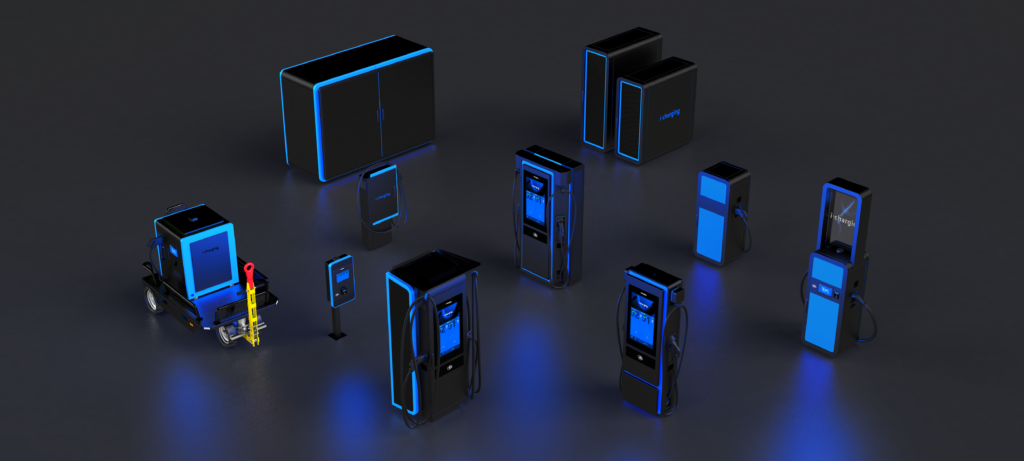
The result is an architecture that covers every electric mobility application from a common foundation. All-in-one solutions for locations where space matters and full charging performance is required. Distributed systems that separate power from user interfaces, enabling any configuration for any operation, expandable at any time, building on what is already installed. Power that scales from 50 kW to 1.6 MW within the same architecture, serving urban retail, large charging hubs, fleet depots, heavy-duty freight terminals and urban air mobility from a single platform.
Power that never sits idle
At the core of the i-charging ecosystem is a patented capability that changes the economics of every installation: dynamic power allocation.
Rather than fixing power to individual outputs, dynamic power allocation (EP4247656A1) distributes available capacity across all active sessions in real time. Installed power is never idle. As vehicles connect and disconnect, capacity is redistributed automatically, maximising throughput, reducing total charging time across all connected vehicles, and delivering higher return on every installation without additional infrastructure.
Infrastructure that grows without starting over
The distributed architecture was designed with a specific operational reality in mind: operations evolve, and infrastructure must evolve with them.
Power units scale internally in 50 kW steps, expanding capacity without changes to existing cabling or user units. As fleet size grows, as vehicle types change, as charging demand increases, the infrastructure adapts. The initial investment retains its full value.
The same principle applies across the full range. From a compact urban installation to a hub-scale operation handling up to 1.6 MW across eight vehicles simultaneously, the architecture is the same. The platform that serves a retail destination today can serve a heavy-duty freight terminal tomorrow.
Visibility that reduces intervention
Infrastructure performance depends as much on operations as on hardware. my.i-charging gives complete visibility over the entire charging network from a single platform, with real-time status of every charger and component, component-level diagnostics accessible remotely, and firmware, software and content updates deployed across the full network without field intervention.
One action. The entire network updated.
Energy that works for the operation
omni-e extends the ecosystem beyond charging into active energy management, balancing EV charging demand with local generation, storage and other site loads according to each operation’s priorities. Charge when energy is cheapest. Prioritise renewable generation when available. Integrate battery storage to maximise self-consumption. All configurable per site, monitored via my.i-charging.
Power2Drive 2026
i-charging will be at Power2Drive 2026, booth B6.340, from 23 to 25 of June.